Loading
The word the whole epic turns on
Dharma
Rendered as duty, righteousness, or the right way to live — and none of those is quite it. In the Mahabharat it is the thing that holds a situation together, and Krishna keeps refusing to let it be simple. The five he names — the five pillars of dharma, set out here as its foundations — are below.
The question
What is dharma?
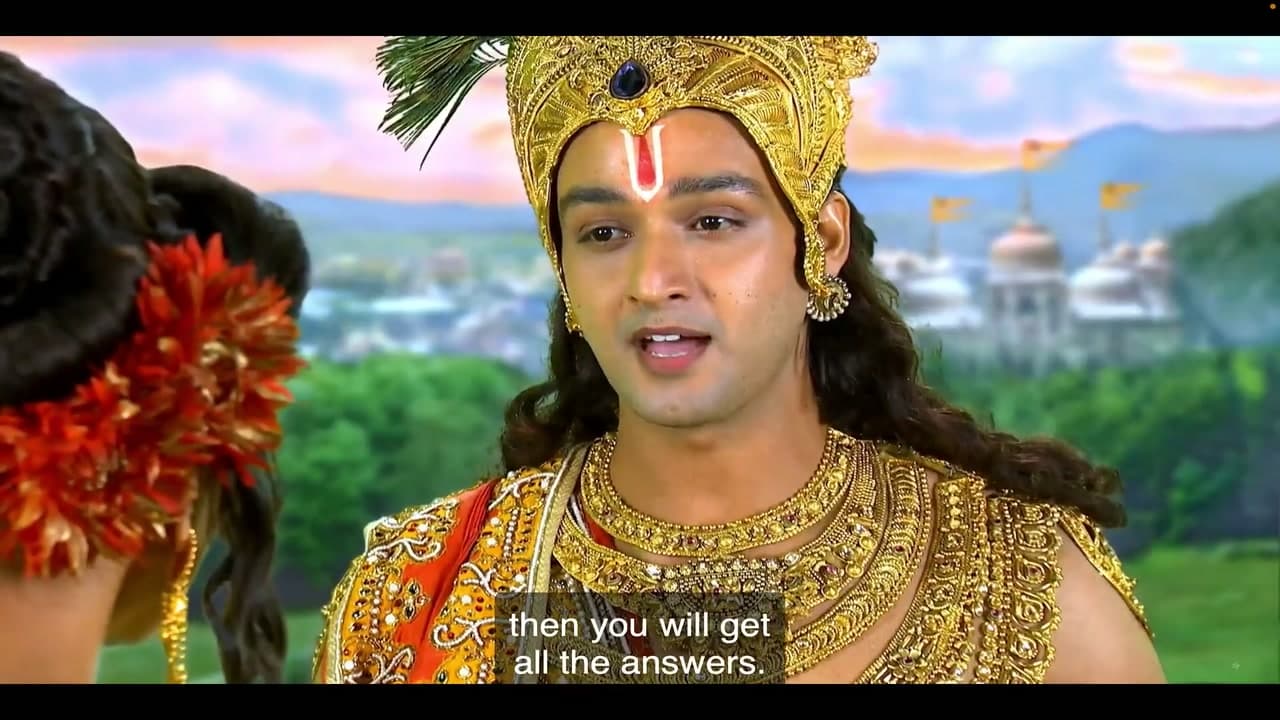
Krishna's answer is not a definition but a direction: dharma is what lets a person live in harmony — with other people, and with the whole of creation. It is what upholds. Wherever it is honoured, a person finds peace.
It is not selfishness dressed as principle. Even a lion, he says, leaves something of its kill for other creatures; an intellect turned toward the good of others is nearer to dharma than one turned only on itself.
And it is never a fixed rulebook. The same vow that is dharma in one moment can become its opposite in the next. That is why the epic keeps returning to a single question: what does this person, in this role, at this moment, actually owe?
Krishna to Draupadi
The five foundations
Before you can know dharma, Krishna says, you must know what holds it up. He names five foundations — and each one settles a different part of you. When all five grow calm and steady, one thing rises in their place.
Knowledge
Jñānasteadies the intellectseeing clearly what you are
Knowledge here is not information but clear sight — knowing what you truly are, and that every living thing shares one source. An intellect lit by that knowledge stops being dragged about by each passing want and begins to hold steady. It is the innate quality of the soul, drawn out not by force but by attention and surrender.
Love
Premasteadies the heartwhere love wakes, conflict falls away
Love steadies the heart because, wherever love is truly awake, disputes, envy and the wish for revenge simply dissolve. The difficulty is that in the moment we quarrel we forget to love — ego wakes, anger wakes, but love does not. The whole practice is to keep love awake even then, and to widen it until it holds not just one person but the whole of creation.
Justice
Nyāyasteadies the soulrooted in compassion, not revenge
Justice is not vengeance. Vengeance is fed by anger and pride; justice is rooted in compassion — it seeks that the wrongdoer feel genuine remorse and that trust be restored to the world. Between the two lies a very small difference, and the name of that difference is dharma. A soul settled in justice can bear even injustice without turning bitter.
Surrender
Samarpansteadies the bodyact fully, without grasping the fruit
Surrender stills the restless demands of body and ego. It is doing what is yours to do, wholly, while letting go of any claim on the result. It is not weakness or defeat; it is the composure of someone who has stopped fighting the current and started to swim with it — offering each act, and its fruit, to something larger than themselves.
Patience
Dhairyasteadies the mindmeet what comes without panic
The restless mind runs ahead to the future and clings to the past. Patience is what lets it rest in the present and meet whatever comes without panic. A patient mind makes better decisions, because it is deciding from stillness rather than merely trying to quiet its own unease — and a calm decision plants a happier future.
When mind, intellect, heart, body and soul all grow calm and steady, the heart fills with compassion — and that is dharma.
What they become
Compassion is the root
Compassion is the acceptance of the whole world: for everyone, only love, and toward no one any opposition. It is the love felt for one person, widened until it holds all of creation. This, the Mahabharat says, is the essence of every dharma. If dharma is a tree, compassion is its root.
Again and again, Krishna says, a person forgets the root and clings instead to a few rules and traditions — and forgets compassion altogether. That is when the world fills with conflict, envy and revenge. Dharma is remembered by returning to the root.
Dharma-sankaṭ
When dharma itself is the hard part
Sometimes every path breaks something you value — to hold to dharma is itself the crisis, and to let it go is the easy way out. Most people never even notice the choice; they drift toward the easy thing, Krishna says, the way a fly drifts toward jaggery. The counsel is not a rule but a posture: don't be frightened by the struggle, don't be lured by the ease, and stand on what is highest.
The leaf that fights the storm, even as it falls from the tree, rises toward the sky; the leaf that bends to the wind is left lying on the ground.
In the teachings' own words
Lines on dharma, each from the clip it was spoken in.
If dharma is a tree, then compassion is its root, its very foundation.
Between justice and vengeance there lies a very small difference — and the name of that difference is dharma.
The foundation of all happiness is dharma, and that dharma dwells within the human heart.
Where it comes from
Begin where the question begins
This page is drawn from a single teaching — Krishna asking Draupadi who she really is, and naming the five foundations of dharma. Watch it in full, or read on through chapter 26.